History of Programming Languages & Their Evolution
Arko Mandal Arko Mandal /assets/img/posts/2025-12-11-history-of-programming-languages-and-their-evolution/banner.jpg
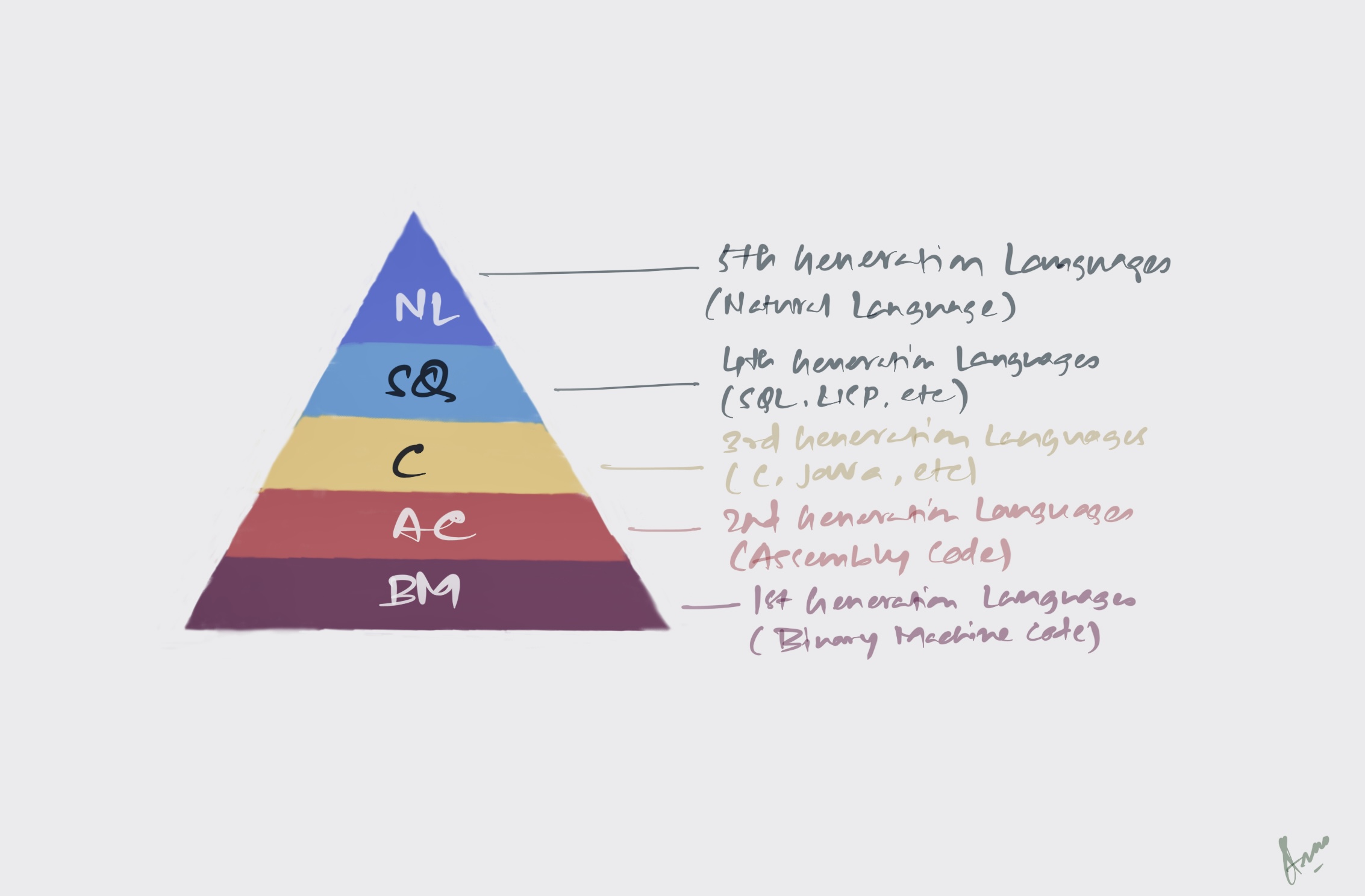
Programming languages have evolved through generations—from machine-level to highly abstract, human-friendly languages. Each generation improved readability, productivity, portability, and problem-solving capability.
1. First Generation (1GL) – Machine Language (1940s–1950s)
What it was
- Direct binary (0s and 1s) instructions executed by hardware.
Why it mattered
- Fastest execution, closest to hardware.
Limitation
- Extremely hard to write, read, and debug.
2. Second Generation (2GL) – Assembly Language (1950s)
What it was
- Mnemonics (e.g.,
MOV,ADD) instead of binary. - Needs an assembler to convert to machine code.
Why it mattered
- Gave humans a slightly easier way to write programs.
- Still hardware-specific.
Examples
- Assembly (x86, ARM, MIPS)
3. Third Generation (3GL) – High-Level Languages (late 1950s–1980s)
What it was
- Human-readable languages using English-like syntax.
- Portable across machines via compilers/interpreters.
Why it mattered
- Massive jump in productivity.
- Foundation of modern software engineering.
Major 3GL Languages and Purposes
| Language | Year | Purpose |
|---|---|---|
| Fortran | 1957 | Scientific & mathematical computing |
| COBOL | 1959 | Business applications, banking |
| ALGOL | 1960 | Foundation for many later languages |
| BASIC | 1964 | Beginner-friendly learning |
| C | 1972 | Systems programming, OS (e.g., UNIX) |
| C++ | 1983 | Object-oriented extension of C |
| Java | 1995 | Platform-independent, enterprise |
| Python | 1991 | Readable, scripting, data science |
| JavaScript | 1995 | Web interactivity |
4. Fourth Generation (4GL) – Problem-Oriented Languages (1980s–1990s)
What it was
- Designed to solve domain-specific tasks with minimal code.
Examples
- SQL – Databases
- MATLAB – Mathematics/Engineering
- R – Statistics
- ABAP – SAP Business
- PowerBuilder / Oracle Forms – Rapid application development
Purpose
- Move closer to what to do instead of how to do.
5. Fifth Generation (5GL) – AI & Logic Programming (1990s–today)
What it was
- Designed for constraint-based or logic-based problem-solving, where the programmer specifies what the solution should satisfy (rules, constraints, or logical relationships), and the system (often an inference engine) figures out how to solve it without an explicit algorithm. This is heavily tied to AI research and declarative programming.
Examples
- Prolog
- LISP
- Mercury
- Constraint-based languages
Used in
- AI research
- Expert systems
- Natural language processing
Overall Evolution Pattern
Lower Level -> Higher Level -> Domain-Specific -> AI/Logic -> Safety & Performance
Key Shifts:
- Hardware-focused → Human-focused
- Manual memory → Automatic memory management
- Procedural → OOP → Functional → Multi-paradigm
- Monolithic → Distributed/Cloud-native
- Sequential → Concurrent & Parallel
- Static → Dynamic → Gradual typing
The quiet shift is unmistakable: we once shaped ourselves to speak like machines, but now machines are learning to speak like us. This evolution isn’t just technical—it marks the beginning of a new era where human intent becomes the center of creation, and technology moves toward us rather than away from us.